
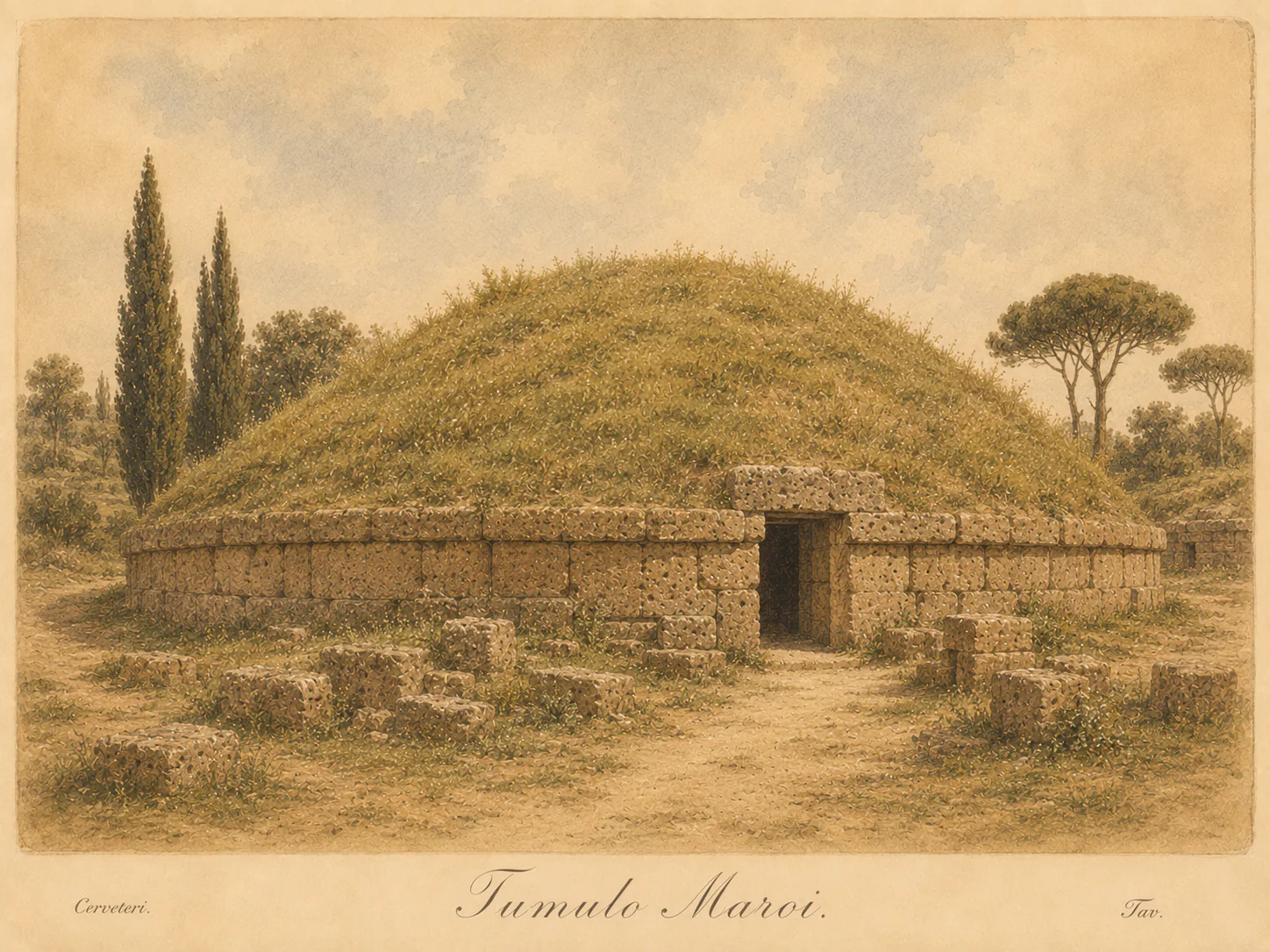
The Maroi Tumulus contains three tombs built over roughly a century, from the second half of the 7th to the second half of the 6th century BC. This long sequence makes the complex especially useful for tracing the transition from great Orientalising mounds to the more regular forms of the Archaic period. It belongs to the landscape of great tumuli in the north-eastern sector, beside the Colonnello and Mengarelli monuments, where tombs and paths form a planned and hierarchical ensemble.
What to look for
Do not look for a single “date” for the whole mound: its three tombs show how a family monument could grow and change over generations.
Discovery and excavation
The number of tombs and chronological range are documented in the UNESCO dossier; Maroi is a modern place-name linked to the history of excavation.